




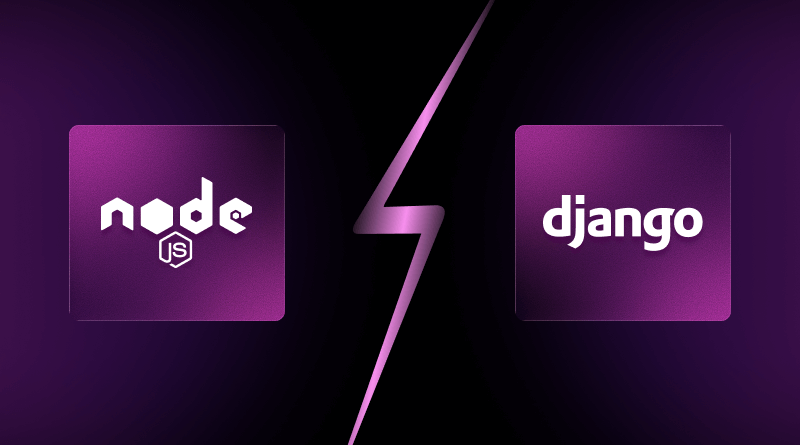
Instagram runs on Django with 2 billion users. Netflix powers 280 million streams with Node.js. Both scale massively. So how do you pick in 2026?
Here’s the truth most comparison posts miss: there’s no “best” framework. Your choice depends on three concrete things: your app type, team skills, and scaling needs.
I’ve built both frameworks extensively – a SaaS dashboard took 3 days in Django vs 10 days for an equivalent Node.js real-time API.
Let me break down what actually matters now with fresh 2026 benchmarks.
What Changed Since the 2023 Framework
Django evolved dramatically. Version 6.0 (December 2025) introduced Template Partials, Background Tasks, and built-in Content Security Policy alongside continued ASGI improvements, hitting 850k+ requests/second.
Node.js doubled down. Node.js 25 (October 2025, Current release) delivers 1.2M+ JSON responses/second with the latest V8 engine optimizations. Node.js 24 entered LTS in October 2025 and is recommended for production.
Ecosystem shifts:
- Next.js 16.1 API routes blur the frontend/backend line
- Both frameworks now handle GraphQL natively
Current Django & Node.js Comparison:
| Feature | Django (Python) | Node.js / Deno (JS/TS) |
| Release | Django 6.0.1 (Python 3.14) | Node.js 24.12 LTS + Deno 2.6 |
| Language | Python (readable, AI-ready) | JavaScript / TypeScript |
| Async Support | Full ASGI (Advanced async ORM) | Native Event Loop (Always async) |
| Startup Time | ~180ms (Optimized) | ~75ms (V8 / Rust core) |
| JSON/sec | ~880k reqs (TechEmpower R23) | ~1.3M+ reqs (TechEmpower R23) |
| Best For | Enterprise, AI integration, Admin | Real-time, Edge, Microservices |
Django ships like a pre-assembled house. Install once, and everything works.
Rapid prototyping dominates everything else. The admin panel delivers instant CRUD UI perfect for content teams or SaaS dashboards. ORM eliminates 90% of SQL writing. Authentication, permissions, forms? Zero config.
Real example: Built client project dashboard (users, billing, reports) in 3 days. Equivalent Node.js took 10 days of package hunting and wiring.
2026 killer feature: ASGI maturity. Django 6.0 async views + Django Channels handle WebSockets cleanly. TechEmpower benchmarks show Django matching Node.js for JSON APIs (850k vs 1.2M req/sec). Good enough for 95% of SaaS workloads.
Security-first design saves headaches. CSRF tokens, SQL injection blocks, XSS filtering, rate limiting – all default. One junior dev mistake won’t expose your entire app.
Enterprise sweet spot: Complex business logic, audit trails, compliance (SOC2, GDPR). Pair with a Reliable hosting provider, and Django scales to millions.
Node.js + Deno: Milliseconds Actually Matter Here
Node dominates scenarios where latency kills user experience.
Real-time performance remains unbeatable. Socket.io WebSockets require zero boilerplate. Chat apps, collaborative editing, multiplayer games, live dashboards – Node handles 1M+ concurrent connections without blinking.
The full-stack JavaScript ecosystem exploded. Next.js 16.1 (December 2025) with stable Turbopack and Cache Components eliminates the need for separate backends with 10-14x faster dev startup times. Deno’s TypeScript-first approach + zero-config security beats Node.js package vulnerabilities.
Microservices were built for this. Uber processes 130M ride requests/month using Node’s event-driven model. Containers deploy in seconds. Horizontal scaling becomes trivial.
Decision Matrix: Match Framework to Your Reality
| Reality Check | Django 6.0 / 5.2 (LTS) | Node.js 24 (LTS) / Deno 2.x |
| App Type | The Monolith / AI Hub: Complex logic, internal tools, and heavy data. | The Real-time Specialist: Streaming, chat, and high-concurrency APIs. |
| E-commerce / CMS | Batteries-in: Frameworks like Saleor and Wagtail handle 90% of wiring out of the box. | Custom storefronts: Better for headless builds; great for carts but requires manual inventory logic. |
| Real-time Chat | Channels 5.0: Robust for business-logic chat and now fully async integrated. | Socket.io / Native: Event loop handles ~3× more concurrent users with lower latency. |
| Microservices | DRF / Ninja: Stronger after Django 6.0 async ORM improvements, but still heavy for Lambdas. | K8s-native: Lightweight (~75ms startup) makes it ideal for scalable microservices. |
| Data / ML Heavy | Native integration with Pandas, NumPy, and PyTorch through the Python ecosystem. | Weak for heavy math; best used as a traffic controller for AI workloads. |
| Team Skills | Python-first: Preferred for data-savvy teams and rapid backend scaling. | Full-stack JS: One language (TypeScript) from database to browser. |
| MVP Timeline | ~2× faster shipping thanks to a production-ready admin panel. | Slower initial build due to middleware and tooling selection. |
| Budget | Predictable and cheaper to maintain long-term using the Django ecosystem. | Higher long-term risk due to dependency churn and npm security debt. |
Real Companies Using Each (Updated Jan 2026)
Django enterprise backbone:
• Instagram (2B users): Django core + microservices hybrid
• Spotify (600M users): Django APIs + ML recommendations
• Pinterest (500M MAU): 100B+ pageviews/month on Django ORM
• Dropbox (700M users): Authentication + file metadata
Node.js real-time leader:
• Netflix (280M subscribers): Node microservices + Open Connect
• Uber (130M rides/month): Real-time tracking + dispatch
• LinkedIn (1B users): Mobile APIs + notifications
• PayPal: 33% less code vs Java backend
Pattern: Django owns structured data + admin. Node.js rules real-time + APIs.
Conclusion
Django and Node.js aren’t rivals – they’re tools for different jobs. Django ships complex CRUD apps 2x faster with admin and security baked in. Node.js crushes real-time APIs and microservices that run in milliseconds.
Your move: Prototype both on a side project. Django for SaaS dashboards. Node.js for chat prototypes. Measure your workflow speed, not internet opinions.
Reality in 2026: 80% apps don’t need Node’s concurrency edge. Django ASGI handles most workloads fine. Pick what lets your team ship fastest. Need a VPS that scales both? Framework choice matters more than hosting debates.
FAQs
Django wins hands down. Python reads like English; the admin panel provides an instant CRUD UI, with auth/ORM included out of the box. Node.js async (promises, event loops) confuses newcomers – mastering callbacks takes weeks.
Node.js edges JSON APIs significantly (1.2M vs Django ~880k req/sec per TechEmpower R23 benchmarks for Django 6.0). Django ties database ops (~450k/sec both). Real-time WebSocket connections? Node handles 3x concurrent users.
Yes, via Django Channels running ASGI WebSockets – Instagram uses it for notifications at a 2B user scale. Not as seamless as Socket.io native implementation, but absolutely production‑ready for 1M+ concurrent users.
Node.js dominates microservices – 80 MB Docker containers vs Django 300MB images. Kubernetes deploys 3x faster, scales horizontally effortlessly. Uber/Netflix architectures prove a million-request scale.
Django takes this clearly (Saleor/Oscar Commerce frameworks). Batteries‑included carts, payment gateway integration, inventory management, and an admin dashboard for non-technical staff. Scales to Pinterest e-commerce levels (500M users). Node.js requires assembling a package ecosystem (Stripe integration, custom cart libraries) – significantly more wiring time.
Deno does completely (TypeScript first, zero config). Node.js via ts-node/esbuild loaders (solid but setup required). Django remains Python‑only – no native TypeScript backend support. Frontend JavaScript teams love the full-stack TypeScript consistency of Node.js and Deno.
Node.js runs 20% lighter on RAM consumption at massive scale – an advantage of microservices architecture. Small- to medium-sized applications have identical hosting costs ($25-40/mo for a VPS). Django ASGI optimization in 5.2 significantly closed the historical performance gap.