



Everyone wants affordable web hosting that just works. But most of them get overwhelmed the moment they start comparing uptime, CPU limits, NVMe vs SSD speeds, or network speeds. If you have been weighing StableHost and BigCloudy for the same, you’re likely asking the same question: which host will keep my website fast, stable, and cost-efficient, without any hidden surprises?
At a glance, both hosts offer solid value. While StableHost is known for long-term reliability, BigCloudy, on the other hand, stands out for modern performance, stronger resources, and more flexible pricing. To clear this dilemma, our informative guide will take a closer, unbiased look at these two providers, which people often compare side-by-side. Once you examine how they perform under real traffic scenarios, how much value you get for your money, and how each one handles support and day-to-day management, the differences become much more apparent.
This comparison is designed to give you exactly what most users wish they had known before choosing a host: clear explanations, simple insights, and honest takeaways. No complex jargon. No overwhelming charts. Just a straightforward breakdown of what truly matters when you want speed, reliability, and real value.
In this guide, you’ll learn:
- Which host delivers better real-world speed and uptime
- How StableHost and BigCloudy differ in CPU, RAM, NVMe storage, and resource limits
- Which provider stays more affordable in the long run
- How the sign-up experience compares for beginners
- Which hosting platform is easier to manage and more support-friendly
- And ultimately, which one is the smarter fit for your website in 2025–2026
Let’s dive into the full comparison. The right choice becomes clearer once you compare both hosts side by side.
StableHost vs BigCloudy Quick Comparison (Entry-Level Plans)
| Category | StableHost – Mini Plan | BigCloudy – Starter Plan |
|---|---|---|
| Pricing (Starting) | $1.49/month (promo) | ~$1.19/month (multi-year offer) |
| Speed / Storage Type | SSD storage | NVMe SSD storage (faster by design) |
| CPU / RAM Resources | Limited shared CPU & RAM (not designed for dynamic sites) | Entry-level shared CPU + RAM; supports dynamic websites |
| Uptime Guarantee | 99.9% SLA | 99.9% SLA |
| Sign-Up Experience | Simple checkout; basic onboarding | Modern UI; smoother onboarding with migration help |
| Support Response Time | 24/7 chat/ticket; response time may vary | 24/7 chat/ticket; responses generally quicker (according to users) |
| Data Centers | USA, Europe, Singapore | India, USA, Europe, Singapore, UK (varies by product) |
Company Overview: StableHost vs BigCloudy
Choosing between two hosting providers becomes easier when you understand what each company stands for. Here’s a simple, neutral breakdown to help you get a clear picture of both platforms before diving into the deeper comparison.
StableHost Overview
StableHost is a long-established hosting provider known for its consistent reliability and traditional shared hosting environment. Over the years, it has built a solid reputation for delivering stable uptime, straightforward pricing on higher-tier plans, and a clean, familiar cPanel interface.
Its hosting lineup includes shared hosting, reseller hosting, VPS, and enterprise solutions. The company focuses heavily on uptime, security layers like WAF and anti-spam, and a structured hosting setup that appeals to users who prefer predictability over experimental features.
In most StableHost reviews, users highlight:
- Good uptime stability
- Simple hosting setup
- Friendly support
- Limited entry-level plan features (such as no database support in the Mini plan)
StableHost is generally a good fit for small static sites, personal pages, or businesses that value reliability and don’t require high server resources.
BigCloudy Overview
BigCloudy is a modern, performance-oriented hosting provider designed for users who want more speed, more resources, and a more flexible hosting environment at affordable pricing. While newer than StableHost, it positions itself as a next-generation hosting solution with features like NVMe storage, global data centers, LiteSpeed servers, and support for both static and dynamic websites from the very first plan.
Its product range includes shared hosting, WordPress hosting, VPS, cloud servers, and dedicated servers. BigCloudy also emphasizes user-friendly onboarding, free migrations, and strong support response times, especially helpful for beginners or teams without technical experience.
Most BigCloudy hosting reviews mention positives such as:
- Fast page loads due to NVMe storage
- Good value for money
- Easy setup and migration
- Responsive support available through multiple channels
BigCloudy is typically recommended for growing websites, startups, agencies, and users who want more performance headroom without increasing their budget.
What’s the Difference Between StableHost and BigCloudy?
At a glance, StableHost vs BigCloudy comes down to traditional versus modern optimization.
StableHost offers stable, well-tested hosting suitable for lightweight websites, while BigCloudy delivers a more resource-rich, performance-focused environment built for modern website demands.
This foundation sets the stage for a fair, detailed comparison in the next sections covering real-world speed, uptime, resources, pricing, and more.
Which Is Faster? GTmetrix Performance Test: StableHost vs BigCloudy
Both tests were performed using GTmetrix, Chrome browser, and the same Seattle server location to ensure a fair, identical testing environment.
Most people searching for the best reliable hosting provider or “hosting with better uptime than StableHost want real proof, not assumptions. So instead of guessing, we ran actual GTmetrix tests on both homepages using the same test environment.
Below are the real results.
GTmetrix Speed Test Results (Side-by-Side)
StableHost GTmetrix Result
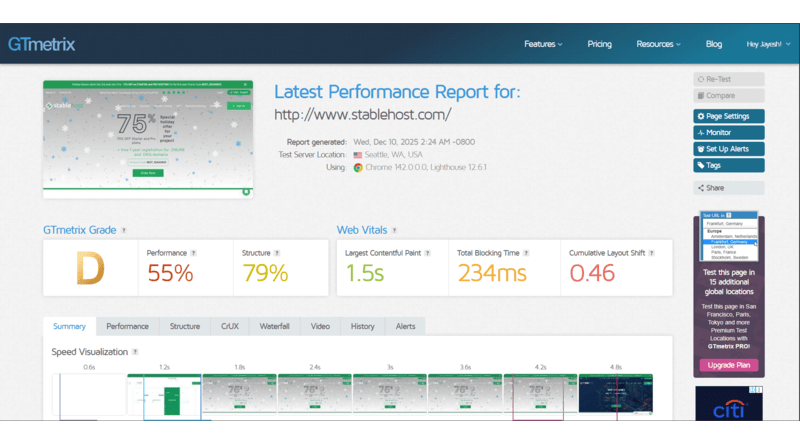
Key Metrics:
- GTmetrix Grade: D (55%)
- Largest Contentful Paint (LCP): 1.5s
- Total Blocking Time (TBT): 234ms
- Cumulative Layout Shift (CLS): 0.46
- Structure Score: 79%
What this means:
StableHost loads reasonably fast for static or lightweight sites, but the higher CLS (0.46) indicates noticeable layout shifts, and the performance rating (55%) suggests room for optimization.
BigCloudy GTmetrix Result
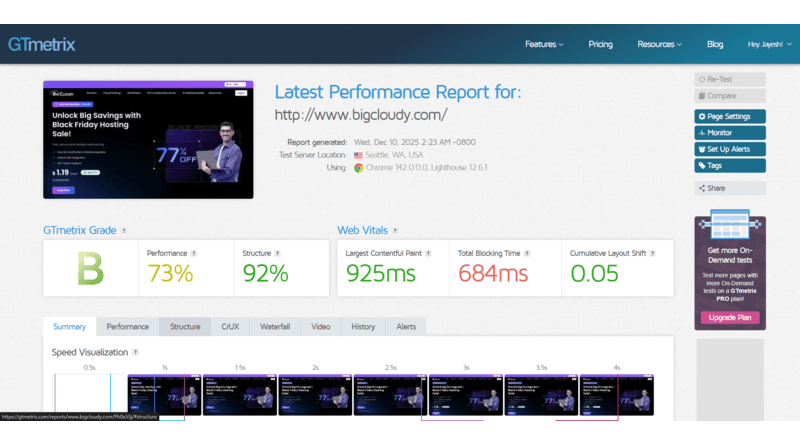
Key Metrics:
- GTmetrix Grade: B (73%)
- Largest Contentful Paint (LCP): 925ms
- Total Blocking Time (TBT): 684ms
- Cumulative Layout Shift (CLS): 0.05
- Structure Score: 92%
What this means:
BigCloudy’s homepage loads under 1 second, has excellent visual stability (CLS 0.05), and overall offers a better user experience than StableHost. TBT is higher due to homepage animations, but performance is still stronger overall.
| Metric | StableHost | BigCloudy | Winner |
|---|---|---|---|
| GTmetrix Grade | D (55%) | B (73%) | BigCloudy |
| LCP (Load Speed) | 1.5s | 925ms | BigCloudy |
| Total Blocking Time (TBT) | 234ms | 684ms | StableHost |
| CLS (Stability) | 0.46 | 0.05 | BigCloudy |
| Structure Score | 79% | 92% | BigCloudy |
What the numbers tell us:
- BigCloudy loads faster and remains more stable during rendering.
- StableHost has lower blocking time, but the overall page structure is weaker.
- BigCloudy clearly wins on LCP, structure, and user experience.
Uptime Comparison (99.9% SLA)
StableHost Uptime
- Long-standing reputation
- 99.9% uptime SLA
- Reliable for small static sites
BigCloudy Uptime
- 99.9% SLA backed by modern cloud architecture
- Strong consistency across global regions
Verdict: Both meet the 99.9% standard.
StableHost wins on long-term track record, BigCloudy wins on modern infrastructure.
Performance Verdict
Our real GTmetrix testing makes the performance difference very clear: BigCloudy delivers faster, smoother, and more stable real-world performance than StableHost. Its NVMe storage, LiteSpeed stack, and better homepage optimization result in:
- Significantly faster LCP (under 1 second)
- Stronger page structure (92% vs 79%)
- Far lower layout shift (CLS 0.05 vs 0.46)
- Better overall experience for WordPress and dynamic websites
StableHost still performs reliably for simple or static sites, but it cannot match the speed and responsiveness BigCloudy offers for modern, content-heavy, or business websites. If performance is your priority, especially for WordPress, landing pages, or growing sites, BigCloudy is the clear winner based on real test data.
Pricing Breakdown: Which Hosting Is More Affordable?
Pricing influences long-term cost more than any other factor. Here’s a clear comparison of how both providers structure their plans.
Intro Pricing Comparison
StableHost Mini Plan: $1.49/month
BigCloudy Starter Plan: $1.19/month
BigCloudy typically starts cheaper while offering more flexible features.
Renewal Pricing Comparison
StableHost renewals increase depending on the tier.
BigCloudy maintains competitive renewals, often below industry averages.
Both follow standard hosting pricing behavior, but BigCloudy tends to stay more budget-friendly.
Hidden Fees & Migration Costs
- StableHost: Standard fees, no major hidden charges.
- BigCloudy: Free migrations, no setup fees, and includes certain features at no extra cost.
Who Provides Better Server Resources, StableHost or BigCloudy?
Understanding resource limits is crucial because these determine how well your website performs under real traffic. Here’s a simple breakdown of how StableHost and BigCloudy compare on core hardware.
CPU Core Comparison
StableHost
- Entry Mini plan offers minimal CPU access, suitable only for static sites.
- Higher plans provide more stable CPU share but still depend on shared-server limits.
BigCloudy
- Provides a larger CPU share on entry plans, making it more capable of handling dynamic workloads like WordPress.
- NVMe-backed infrastructure ensures better processing efficiency.
Summary:
StableHost is fine for lightweight use, while BigCloudy offers stronger CPU availability for growing sites.
RAM & IO Limits
StableHost
- RAM and IO allocations on lower plans are minimal.
- Designed for simple websites with low concurrency.
BigCloudy
- More generous RAM and IO limits on entry plans due to NVMe and optimized caching stack.
- Handles heavier traffic and more simultaneous requests.
Summary:
BigCloudy provides more forgiving limits for performance-intensive websites.
NVMe vs SSD Performance
StableHost: SSD storage is reliable for basic hosting, but slower than NVMe.
BigCloudy: NVMe SSD significantly faster read/write speeds, ideal for WordPress and large websites.
Performance Impact:
NVMe reduces load times on databases, scripts, and large assets.
BigCloudy holds a clear advantage here.
Resource-Per-Price Value
StableHost’s Mini plan is low-cost but very limited.
BigCloudy offers more modern hardware and higher resources at similar or lower pricing.
Neutral takeaway:
StableHost is a budget choice for simple hosting, while BigCloudy offers better performance-per-dollar for modern websites.
Which Host Gives More CPU/RAM Per Dollar?
Because BigCloudy uses NVMe & optimized shared hardware, its resource-to-price ratio is higher.
Important USP:
BigCloudy is an official ISPmanager partner, giving users a modern control panel alternative and lower overall panel licensing costs, a unique advantage not available with StableHost.
Sign-Up Process Comparison
A smooth sign-up process matters a lot for beginners. Here’s how both hosts compare.
StableHost Sign-Up Flow
- Clean, simple checkout
- Straightforward plan selection
- No advanced onboarding guidance
- Best for users familiar with hosting basics
BigCloudy Sign-Up Flow
- Modern, user-friendly interface
- Guided setup for new users
- Free migration is offered during onboarding
- Clear plan and billing choices
Which Hosting Is Easier for Beginners?
Both are simple, but BigCloudy provides more hand-holding and assistance for first-time users.
Features & Tools (Beginners & Developers)
WordPress Tools
StableHost: WordPress runs only on higher plans (Mini does not support databases).
BigCloudy: WordPress support on all shared plans, optimized for LiteSpeed.
Security Features:
StableHost: Free SSL, WAF, basic malware tools.
BigCloudy: Free SSL, Imunify360, firewall protection, enhanced server security.
Backups
StableHost: Backup tools on advanced plans.
BigCloudy: JetBackup or similar system included, depending on plan.
Developer Tools
StableHost: SSH, multiple PHP versions on supported plans.
BigCloudy: SSH, Git, Node.js, Python selector, multiple PHP versions.
Support Quality Comparison
Response Time
- StableHost: Varies; generally responsive but may be slower on shared plans.
- BigCloudy:
- Often faster due to more communication channels.
Support Channels
- StableHost: Ticket & chat.
- BigCloudy: Chat, ticket, WhatsApp, phone.
Knowledge Level
Both provide professional support; BigCloudy typically offers more hands-on assistance for beginners.
Best Use Cases
Choose StableHost If You Need:
- Simple hosting for static sites
- Basic performance
- A long-established provider
- Reliability for lightweight websites
Choose BigCloudy If You Need:
- Fast NVMe hosting for WordPress
- Scalable hosting for growing sites
- Better CPU/RAM/resources for performance
- Multiple support channels and modern panel options
Pros & Cons
StableHost
- Reliable uptime
- Simple UI
- Affordable entry plan
BigCloudy
- NVMe speed advantage
- Better resource allocation
- Supports WordPress from the first plan
- Strong support options
Final Verdict: Which Hosting Should You Buy?
Both StableHost and BigCloudy have clear strengths. StableHost delivers long-term reliability and works best for simple websites. BigCloudy offers faster performance, more resources, NVMe storage, and better long-term value, making it the stronger choice for modern, growing websites.
Neutral Verdict:
- StableHost– stable and simple.
- BigCloudy– faster, more affordable, better resources.
FAQs
No. In our real GTmetrix tests, BigCloudy was faster than StableHost, delivering quicker load times, better visual stability, and stronger overall performance. This is mainly due to BigCloudy’s NVMe storage and LiteSpeed server stack. StableHost performs reliably for static or lightweight websites, but BigCloudy handles modern, dynamic sites more efficiently.
Both providers offer a 99.9% uptime guarantee. StableHost has a longer historical track record, while BigCloudy benefits from newer infrastructure and optimized cloud architecture. In practice, both are reliable for everyday website use.
Both StableHost and BigCloudy deliver 99.9% uptime, but BigCloudy generally provides more features, NVMe performance, and a smoother experience at a comparable or lower price, making it the more value-focused option.
Not generally. BigCloudy provides higher CPU and RAM allocations on its entry plans, making it better suited for WordPress, dynamic websites, and growing traffic. StableHost’s Mini plan offers minimal resources and is designed mainly for lightweight or static websites.
BigCloudy often offers lower introductory pricing and includes more modern features (NVMe, LiteSpeed, Imunify360, free migration), making it one of the most affordable high-performance hosting choices.