



AI is smart, so why does it still give wrong answers? AI can write code, summarize a 50-page report, and help plan your next project. But ask it something specific about your business, and things get interesting.
It might miss important details. It might use outdated information. Sometimes it confidently gives an answer that simply isn’t true.
The issue isn’t the AI itself. The issue is that it doesn’t have access to the information it actually needs. As AI adoption grows, understanding AI automation becomes equally important. That’s where RAG enters the picture.
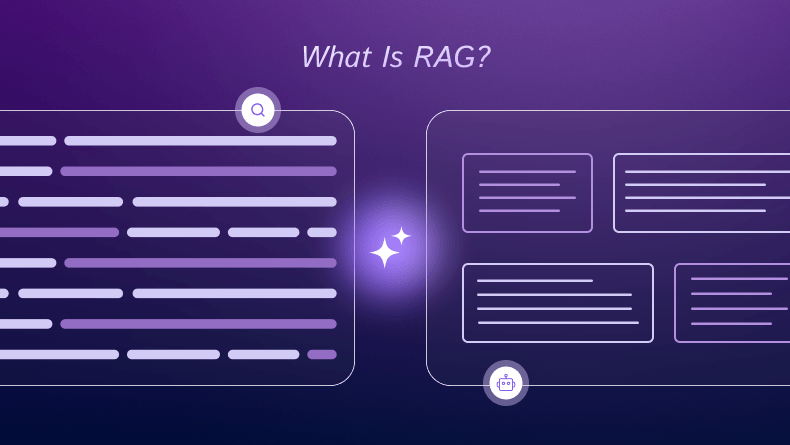
What Is RAG?
RAG, or Retrieval-Augmented Generation, is a technique that helps AI find relevant information before it answers a question. Instead of relying solely on what it learned during training, it retrieves information from trusted sources such as documents, knowledge bases, and databases before generating a response.
Think of it like an open-book exam. A traditional AI model answers from memory, while a RAG-powered system quickly checks the right information before responding.
For example, if a customer asks about your latest pricing plan, a standard AI model may not know it has changed. A RAG system can retrieve the latest pricing details from your website or internal documents and use that information to provide an accurate answer.
This makes RAG especially useful for customer support, business knowledge bases, enterprise search, and any AI application that needs access to current or company-specific information.
How Does RAG Actually Work?
Imagine asking AI a question and instead of answering immediately, it pauses for a second and says, Let me check that.
That’s essentially how RAG works. Before generating a response, the system searches through relevant sources such as company documents, knowledge bases, websites, or databases. It gathers the information most closely related to the question and gives it to the AI as context.
Only then does the AI create its answer. Let’s say a customer asks about a feature that was released last month. A traditional AI model may not know that the feature exists. A RAG-powered system can find the latest documentation, read it, and answer using information that is actually current.
This simple extra step changes everything. Instead of relying entirely on memory, AI gets the chance to check the facts first. The result is answers that are more relevant, more reliable, and far more useful in real-world situations.
Why Do Businesses Need RAG When They Already Have ChatGPT?
When ChatGPT became popular, it showed businesses what AI could do. It could write content, answer questions, and automate tasks within seconds.
But most businesses don’t need generic answers. They need answers based on their own documents, products, policies, and knowledge.
That’s where traditional AI often falls short. It can generate responses, but it doesn’t automatically know what’s happening inside your business.
RAG solves this problem by allowing AI to find relevant information before answering. Instead of relying only on training data, it can work with current business information and provide more reliable responses.
That’s why many businesses are combining GenAI with RAG. They’re not looking for AI that can simply generate text. They’re looking for AI that can generate answers with context.
Why Has RAG Become Essential for Enterprise AI?
Large language models are powerful, but they don’t automatically know your company’s documents, policies, customer data, or internal processes. At the same time, business information changes constantly, making it difficult for AI to stay accurate if it relies only on its training.
This is where RAG makes a difference. It connects AI to your latest business knowledge, allowing it to retrieve relevant information before generating a response. This helps reduce hallucinations, improves answer accuracy, and gives employees and customers more confidence in the results.
For enterprises, RAG isn’t just about smarter AI. It’s about building AI systems that deliver reliable, context-aware, and trustworthy answers based on real business information.
Where Are You Already Using RAG Without Realizing It?
RAG may sound like a new technology, but chances are you’ve already interacted with it. Many of the AI tools people use every day rely on RAG behind the scenes to find information before generating a response.
Customer Support Chatbots
Ever asked a support chatbot about shipping, refunds, or account settings and received a detailed answer pulled from a help center? That’s often RAG at work. Instead of guessing, the chatbot retrieves information from company documentation and responds using that content.
Internal Company Search
Employees shouldn’t have to dig through dozens of files to find a policy or process. Modern workplace search tools use RAG to pull answers from internal documents, wikis, and knowledge bases in seconds.
AI Knowledge Bases
Many businesses now use AI-powered help centers that can answer questions based on articles, guides, and documentation. The AI isn’t memorizing everything. Instead, it retrieves the right information whenever it is needed.
E-commerce Product Recommendations
When an online store suggests products based on your search or helps compare different options, RAG can help connect customer questions with product data, specifications, and inventory information.
Document and Contract Search
Law firms, finance teams, and large organizations often use AI to search through contracts, reports, and business documents. Instead of reading hundreds of pages manually, users can ask a question and quickly find the relevant information.
The interesting part? Most people never notice RAG working in the background. They simply experience faster and more useful answers.
What’s the Difference Between RAG and GenAI?
People often use the terms RAG and GenAI as if they mean the same thing, but they solve different problems.
Generative AI (GenAI) is the technology that creates content, answers questions, writes code, and generates text based on patterns learned during training. RAG enhances that process by giving the AI access to relevant information before it responds.
| Generative AI (GenAI) | RAG (Retrieval-Augmented Generation) |
|---|---|
| Generates answers using training data. | Retrieves information before generating an answer. |
| May provide incorrect or outdated information. | Uses relevant information from trusted sources. |
| Limited to what it has learned. | Can work with current business data and documents. |
| Best for writing, brainstorming, and content creation. | Best for search, support, knowledge bases, and factual answers. |
| Works mainly from memory. | Works with both memory and retrieved information. |
A simple way to think about it is this:
GenAI is the engine. RAG is the navigation system that helps the engine find the right information before moving forward.
This is why many modern AI assistants, support bots, and enterprise search tools combine both technologies. The AI still generates the final response, but RAG helps ensure that the response is based on relevant and reliable information. RAG is not a replacement for GenAI. It is a way to make GenAI more reliable.
Why Does RAG Give Better Answers Than Traditional AI?
Traditional AI answers questions using what it learned during training. RAG takes an extra step by finding relevant information before generating a response. That small difference can have a big impact on the quality of the answer.
It Uses Your Data
A standard AI model doesn’t automatically know what’s inside your company documents, product guides, or internal knowledge base. RAG can access that information and use it when responding to questions.
It Can Access Updated Information
Businesses change constantly. Products evolve, policies get updated, and new content is published. RAG can work with the latest information instead of relying only on older training data.
It Reduces Hallucinations
When AI doesn’t have enough context, it may generate answers that sound convincing but are incorrect. By providing relevant information upfront, RAG helps reduce guesswork and improve accuracy.
It Improves Trust
People are more likely to trust AI when the answers are consistent, relevant, and based on real information. Whether it’s a customer asking for help or an employee searching for a document, reliable answers create a better experience.
In simple terms, RAG helps AI answer with information instead of assumptions.
What Are the 7 Types of RAG?
As RAG technology has evolved, different approaches have emerged to solve different challenges. Some focus on simplicity, while others are designed for complex enterprise systems.
Here are the seven commonly discussed types of RAG and what makes each one different.
Naive RAG
This is the most basic form of RAG. The system retrieves relevant information and sends it directly to the AI model to generate an answer. It is simple to build and works well for straightforward use cases.
Advanced RAG
Advanced RAG improves the retrieval process by ranking, filtering, or refining information before it reaches the AI. This helps deliver more relevant and accurate responses.
Modular RAG
In Modular RAG, different parts of the system can be swapped or customized independently. Businesses often use this approach when they need greater flexibility and control over their AI workflows.
Agentic RAG
Agentic RAG introduces AI agents that can decide how to search, what information to retrieve, and which steps to take before generating an answer. It is designed for more complex reasoning tasks.
Graph RAG
Graph RAG uses knowledge graphs to understand relationships between people, places, concepts, and documents. This helps uncover connections that traditional search methods may miss.
Multimodal RAG
Most RAG systems work with text, but Multimodal RAG can retrieve and process information from images, audio, videos, PDFs, and other content types alongside text.
Hybrid RAG
Hybrid RAG combines multiple retrieval methods to improve search quality. It often blends keyword search with semantic search to find the most relevant information.
Quick Summary of the Different Types of RAG
| RAG Type | Main Purpose |
|---|---|
| Naive RAG | Basic retrieval and answer generation. |
| Advanced RAG | Improves retrieval quality and ranking accuracy. |
| Modular RAG | Provides a flexible and highly customizable architecture. |
| Agentic RAG | Uses AI agents for reasoning and decision-making. |
| Graph RAG | Analyzes relationships and connections between pieces of data. |
| Multimodal RAG | Processes text, images, audio, video, and other data formats. |
| Hybrid RAG | Combines multiple retrieval methods to improve accuracy. |
The best type of RAG depends on the problem you’re trying to solve. While Naive RAG is often enough for simple applications, larger AI systems usually rely on advanced, hybrid, or agentic approaches to deliver more accurate results.
What Tools Are Commonly Used in a RAG System?
A RAG system is usually built using three main components: a place to store information, an AI model to generate answers, and a framework that connects everything.
Vector Databases
Vector databases help store and retrieve information that the AI can use when answering questions.
- Qdrant – Popular open-source option known for speed and flexibility.
- Weaviate – Designed for AI-powered search and knowledge retrieval.
- Pinecone – A managed service that makes it easy to build and scale RAG applications.
AI Models
These models generate the final response after relevant information has been retrieved.
- OpenAI – Widely used for chatbots, search assistants, and business applications.
- Llama 3 – An open-source model that gives businesses more control over their AI stack.
- Mistral – Known for delivering strong performance with efficient resource usage.
- Gemini – Google’s AI model family with support for multiple content types.
Frameworks
Frameworks help connect data sources, retrieval systems, and AI models into a working application.
- LangChain – One of the most widely used frameworks for building AI applications.
- LlamaIndex – Focused on helping AI systems work with documents and knowledge bases.
The exact tools vary from one project to another, but most modern RAG systems are built using a combination of these technologies.
Is RAG Expensive to Run?
The answer depends on how you deploy it. A RAG system usually involves three types of costs:
Embedding Costs
Before AI can search your data, documents need to be converted into a searchable format. This process is called embedding and can create costs when using paid AI services.
Retrieval Costs
Every time a user asks a question, the system searches for relevant information. At scale, storing and searching large amounts of data can add to infrastructure costs.
Generation Costs
Once the information is found, an AI model generates the final answer. If you’re using a commercial AI API, costs often increase as usage grows.
For a small knowledge base or internal tool, the cost may be minimal. However, expenses can increase rapidly for customer-facing applications that process thousands of queries every day. That’s why it’s important to choose the right hosting plan to ensure long-term scalability and reliable performance before moving to a self-hosted solution.
What Hosting Do You Need for a Self-Hosted RAG System?
A self-hosted RAG system needs reliable infrastructure to deliver fast and accurate responses. The right hosting depends on your data size, AI model, and expected traffic.
- RAM: More memory helps the vector database retrieve information faster.
- NVMe SSD: High-speed storage reduces data access time and improves overall performance.
- Multi-Core CPU: Multiple cores handle document indexing, search requests, and AI workloads more efficiently.
- GPU (Optional): A GPU is useful if you’re running open-source AI models locally. If you’re using AI APIs, a CPU server is often enough.
- Low Latency: Hosting closer to your users helps reduce response times and improves the overall experience.
- Server Choice: A VPS is suitable for small to medium RAG applications, while dedicated servers are better for high-traffic workloads. Cloud infrastructure is a good option when you need to scale resources as demand grows.
Choosing the right hosting ensures your RAG system stays fast, responsive, and ready to grow with your AI application.
Can Small Businesses Use RAG?
Absolutely. You don’t need a large enterprise budget to benefit from RAG. Any business that works with information can potentially use it.
Customer Support
Help customers get instant answers from FAQs, policies, and support articles.
Internal Documentation
Allow employees to quickly find information without searching through multiple documents.
Product Catalogs
Help customers compare products and find details using natural language questions.
Knowledge Bases
Turn existing guides, manuals, and documentation into an AI-powered assistant. RAG is often associated with large organizations, but many of its most practical use cases are just as valuable for startups and small businesses.
Why Are Some Companies Self-Hosting Their RAG Systems?
As AI usage grows, some organizations prefer to run their RAG infrastructure on their own servers rather than relying entirely on third-party services.
Data Privacy
Sensitive documents and business information remain within the company’s environment.
Predictable Costs
Instead of paying per request or per token, businesses can work with more consistent infrastructure costs.
More Control
Teams can choose their preferred models, databases, and deployment methods.
Growing AI Workloads
As usage grows, self-hosting can become a practical way to improve performance while keeping infrastructure costs under control.
For many businesses, self-hosting isn’t about replacing AI services. It’s about gaining more control over how those services are delivered.
What Does a Self-Hosted RAG Setup Look Like?
A typical self-hosted RAG system consists of three core components:
Vector Database
Stores information from your documents, knowledge base, website content, or internal resources and helps find the most relevant content for each query.
AI Model
Processes the retrieved information and turns it into a natural, easy-to-understand response.
User Interface
This is where users ask questions and receive answers, whether through a chatbot, search tool, customer portal, or internal assistant.
Together, these components allow AI to work with your own information instead of relying solely on what it learned during training.
Is RAG the Future of Business AI?
For many organizations, the answer is yes. Businesses don’t simply need AI that can generate content; they also require reliable web hosting infrastructure to support AI-powered applications. More importantly, they need AI systems that can deliver accurate responses, understand internal knowledge, and work with real-world information.
That’s where RAG stands out. By connecting AI to trusted data sources, RAG helps bridge the gap between powerful language models and the information businesses rely on every day. As companies continue to adopt AI, systems that can deliver relevant, trustworthy, and context-aware answers are likely to become the standard rather than the exception.
Final Thoughts
AI is no longer the hard part. Making AI accurate, reliable, and useful in real-world situations is where the real challenge begins.
RAG addresses that challenge by helping AI work with current information instead of relying solely on past training. The result is a smarter system that can provide better answers, support better decisions, and create better user experiences.
As AI continues to evolve, technologies like RAG will play a key role in helping businesses turn information into something far more valuable: trustworthy answers.